A diabetic foot problem can worsen without pain, obvious colour change or a dramatic wound. By understanding who needs assessment, what clinicians check and what you must monitor between visits, you can act before a small injury becomes infected, ischaemic or difficult to heal.
Key takeaways
- Schedule a diabetic foot assessment at least once a year.
- Check both feet daily for blisters, cuts, redness, swelling and temperature changes.
- Loss of sensation can hide pressure injuries, burns and ulcers.
- Seek urgent assessment for spreading redness, swelling, drainage, fever or blackened skin.
Who needs a diabetic foot assessment, and how often?
Every person with diabetes needs a diabetic foot assessment at least once a year, even without pain or visible damage. A painless foot is not automatically safe: loss of protective sensation can hide a blister, burn or pressure injury until it becomes an ulcer.
At the first examination, the clinician should:
- Inspect skin colour and temperature, cracks, blisters, calluses, corns, fungal infection, swelling, drainage and odour.
- Look for deformity, limited joint movement and pressure points caused by footwear.
- Feel foot pulses to identify reduced arterial blood flow.
- Test protective sensation with a 10-g monofilament or Ipswich Touch Test. A tuning fork can add neurological information but cannot replace validated protective-sensation testing.
Follow-up becomes more frequent as risk rises:
- Low risk: an annual diabetic foot examination.
- Loss of protective sensation or peripheral artery disease: reassessment every 6–12 months.
- Additional risk factors, such as deformity or kidney disease: reassessment every 3–6 months.
- A previous diabetic foot ulcer or amputation: reassessment every 1–3 months, with protective footwear and rapid review of any new skin break.
Healing does not erase previous risk. Keep scheduled professional checks even when the foot looks normal.
What should you check on your feet every day?
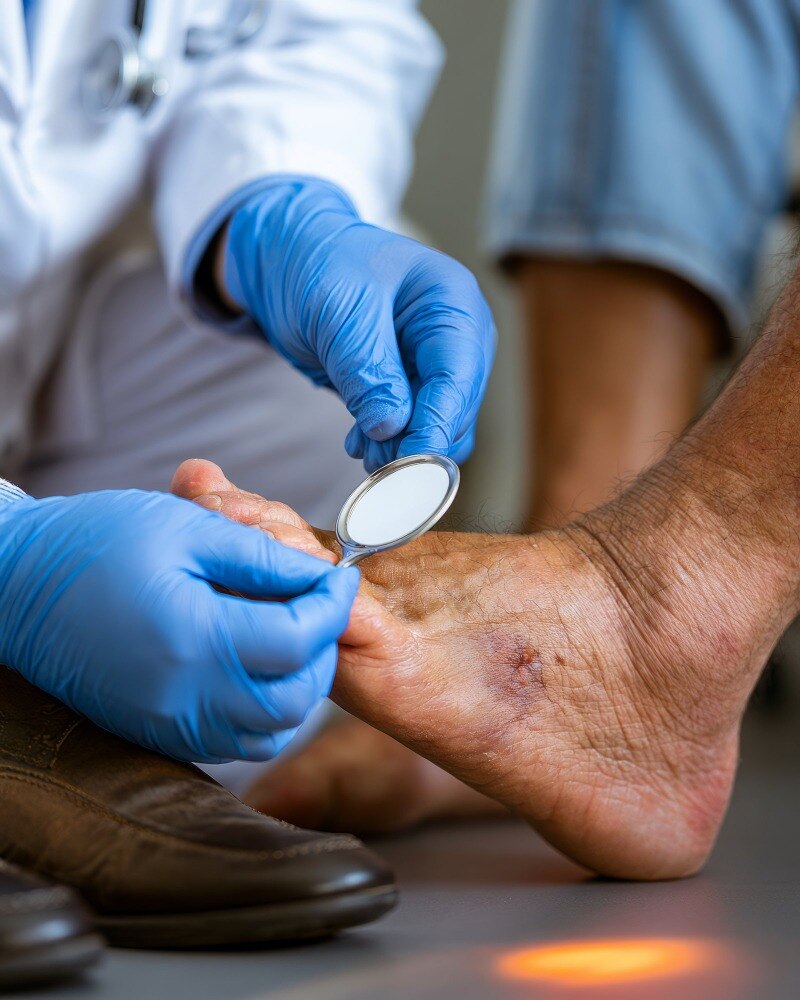
Spend one to two minutes on a daily foot inspection, using a mirror for the soles or asking someone to help. Check both feet in good light and compare one side with the other; do not wait for pain, because nerve damage can hide a serious injury.
Look for these visible changes:
- Redness, unusual paleness, blue or black colour, or skin that feels noticeably colder or hotter
- Foot cracks and blisters, cuts, punctures, open sores or bleeding
- New calluses, corns, pressure marks or a change in toe position
- Peeling, scaling, itching or splitting between the toes, which can indicate fungal infection
- Swelling around the foot, ankle or a single toe
- Drainage, pus, blood, a bad odour or a dressing that becomes wet
The following diabetic foot warning signs need same-day medical attention:
| Finding | What to do |
|---|---|
| New wound, blister that has opened, or skin breakdown | Contact a clinician today, even if it looks small |
| Redness that spreads, warmth, pus, odour or rapidly increasing swelling | Seek same-day assessment for possible infection |
| Black or blue tissue, a cold or pale foot, or sudden colour change | Seek emergency care immediately; this can indicate severely reduced blood flow |
| Fever, chills or feeling acutely unwell with a foot change | Seek urgent medical care |
Do not cut away a callus, puncture a blister or apply a chemical corn remover. Cover an open area with a clean, non-stick dressing and keep pressure off until you receive advice.
Why can a diabetic foot injury be painless yet dangerous?
A foot injury can become dangerous before you feel it. Peripheral neuropathy reduces protective pain and temperature sensation, so a blister, burn, pressure spot or small cut can enlarge into a neuropathic ulcer while you continue walking on it.
- Nerve damage removes the warning signal. Repeated pressure from footwear or an abnormal gait can break the skin, deepen tissue damage and expose bone without causing pain.
- Reduced arterial flow limits oxygen and nutrients. The result is an ischaemic wound with pale, bluish or black tissue that stays cold, fails to close and can deteriorate quickly.
- Diabetes impairs immune responses. A diabetic foot infection can spread through a small break in the skin, and fever may be absent; redness, warmth, swelling, pus or odour are more useful warning signs.
- Delayed healing keeps wounds open longer. Persistent moisture, pressure or callus repeatedly injures the area, allowing a minor wound to become deeper and harder to treat.
Pain therefore cannot tell you whether the injury is minor. A painless ulcer, a cold discoloured toe or a wound that shows no meaningful improvement after four to six weeks of appropriate care needs prompt clinical review, including reassessment of circulation. A superficial swab alone does not prove infection because chronic ulcers are commonly colonised.
Which tests show whether sensation, circulation and pressure are unsafe?
A 10-g monofilament test checks whether you can feel light pressure at standard points on the sole and toes. The Ipswich Touch Test uses brief fingertip contact on the toes. Loss of either result signals loss of protective sensation; a tuning fork can add neurological information but cannot replace a validated sensation assessment.
The examination also covers:
- Skin temperature, colour, cracks, calluses, blisters, swelling, drainage and odour
- Foot shape, claw or hammer toes, high-pressure areas, limited joint movement and suspected Charcot change
- Dorsalis pedis and posterior tibial pulses
- Walking pattern, footwear fit and plantar pressure beneath the heel, metatarsal heads and toes
| Test or finding | What it shows | Important limit |
|---|---|---|
| Ankle-brachial index | Compares ankle and arm systolic pressure to screen for peripheral artery disease | Calcified, stiff arteries can produce a falsely high or noncompressible result |
| Toe-brachial pressure index | Compares toe and arm pressure when ankle arteries are unreliable | A low result supports poor blood flow but does not map the exact blockage |
| Toe pressure and pedal Doppler waveforms | Adds evidence about tissue perfusion and arterial flow pattern | A normal bedside result does not guarantee ulcer healing |
| Plantar pressure or gait assessment | Identifies repeated loading that causes callus or ulceration | It measures mechanical stress, not sensation or circulation |
An ankle pressure below 50 mmHg, ankle-brachial index below 0.5, toe pressure below 30 mmHg or transcutaneous oxygen below 25 mmHg warrants urgent vascular assessment. A non-healing ulcer needs reassessment even when initial tests look acceptable.
When does a foot problem need urgent specialist assessment?
A new diabetic foot ulcer needs prompt specialist review, not routine dressing changes alone. Seek same-day care for spreading redness, pus, foul odour, fever, rapidly increasing swelling, black or blue tissue, or a cold, pale foot.
Infection combined with peripheral artery disease requires urgent assessment by both a vascular or surgical specialist and a diabetic-foot clinician.
Escalate immediately for these warning signs:
- Severe pain at rest, a cold foot, absent pulses, or blackening tissue
- An ulcer with ankle pressure below 50 mmHg, ankle-brachial index below 0.5, toe pressure below 30 mmHg, or transcutaneous oxygen below 25 mmHg
- No meaningful healing after 4–6 weeks of appropriate care
- A deep ulcer, exposed bone, or drainage that raises concern for bone infection
These findings call for urgent vascular assessment and consideration of imaging or revascularisation. A vascular service such as RADIANCE CLINIC can help investigate whether inadequate arterial flow is blocking healing. For suspected osteomyelitis, clinicians combine a probe-to-bone test, plain foot X-rays and ESR, CRP or PCT; MRI helps when those results leave doubt.
Between appointments, keep pressure off the wound, follow dressing instructions, and never walk barefoot. A neuropathic plantar ulcer often needs a non-removable knee-high device, such as a total-contact cast, when safe. Check your feet daily, wear properly fitted shoes, avoid self-cutting calluses, and keep every review even after closure because recurrence remains a long-term risk.
Frequently asked questions
Who needs a diabetic foot assessment, and how often?
Every person with diabetes needs a foot assessment at least once a year, including people without pain or visible damage. More frequent reviews apply when you have numbness, poor circulation, a previous ulcer or amputation, foot deformity, kidney disease or difficulty checking your feet.
What should you check on your feet every day?
Inspect both feet, including between the toes and the soles, for cuts, blisters, cracks, redness, swelling, bruising, drainage, fungal infection and colour or temperature changes. Check your socks and shoes for grit, rough seams or blood.
Why can a diabetic foot injury be painless yet dangerous?
Diabetes can damage nerves and reduce protective sensation, so you may not feel heat, friction, pressure or a wound. An unnoticed injury can worsen into an ulcer or infection.
Which tests show whether sensation, circulation and pressure are unsafe?
Clinicians assess sensation with a 10-gram monofilament and vibration testing, examine pulses and skin temperature, and use an ankle-brachial pressure index or toe-brachial index when circulation is a concern. They also inspect footwear, gait and pressure points.
When does a foot problem need urgent specialist assessment?
Seek urgent care for a new wound, spreading redness, warmth, swelling, pus, foul odour, fever, sudden colour change, black skin, severe pain or a cold foot. Arrange prompt assessment for any wound that is not healing.