Laser hair removal works best when you understand what the device targets, how your hair growth cycle affects timing, and why skin tone changes the safety calculation. By the end, you will know how to judge likely results, compare laser with other hair-removal methods, prepare properly, and identify the questions a clinician must answer before treatment.
Key takeaways
- Expect long-term reduction, not guaranteed permanent removal of every hair.
- Avoid waxing and plucking before treatment; shave the area instead.
- Ask who will operate the laser and how settings suit your skin tone.
- Judge progress across treatment sessions and regrowth cycles, not after one visit.
How laser energy reduces hair growth instead of removing every hair permanently
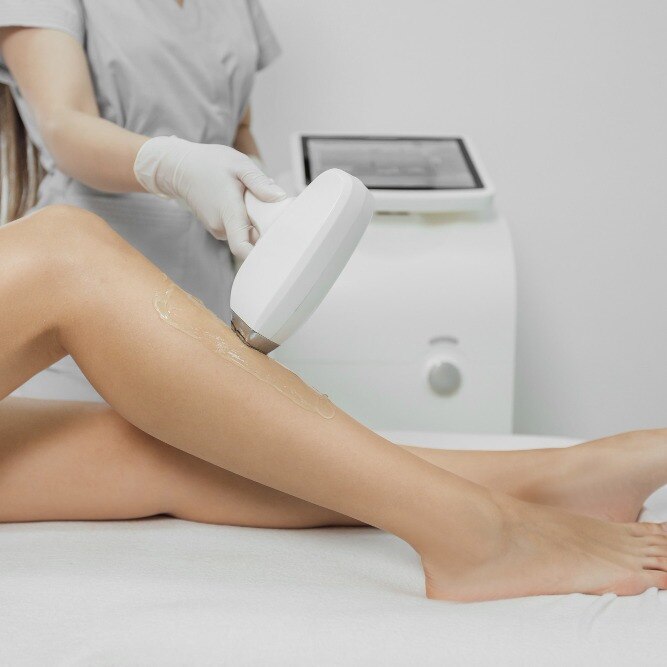
Laser hair removal uses selective photothermolysis: the device delivers a chosen wavelength of light that is absorbed more strongly by melanin in the hair than by surrounding skin. This melanin absorption converts light into heat, allowing heat delivery to the follicle and damaging the structures that produce the hair.
The treated hair sheds over the following days or weeks; it is not pulled out during the appointment.
One session cannot affect every follicle because hairs grow asynchronously. Laser energy works best during the anagen phase hair growth cycle, when the hair contains enough pigment and remains connected to the follicle’s growth centre.
- Expect several sessions because only a portion of hairs are in anagen at each appointment.
- Schedule treatments according to the body area and regrowth, not a fixed weekly timetable; intervals commonly range from about four to eight weeks, with body areas often needing longer gaps.
- Avoid judging the result after one session: treated hairs may grow more slowly, become finer, or fail to return.
- Plan for maintenance when previously quiet follicles produce new hairs or regrowth becomes noticeable.
The accurate goal is long-term hair reduction, not guaranteed permanent hair removal. “Permanent hair reduction” means a stable decrease in regrowth measured at six, nine, and twelve months after the completed regimen. Dark, coarse hair usually responds best; white, grey, blonde, and red hair often responds poorly because it contains little usable melanin.
Facial reduction is less predictable, and new androgen-sensitive growth from polycystic ovary syndrome or another hormonal disorder warrants medical assessment alongside treatment.
Which hair, skin and health factors determine whether treatment is suitable
Your likely response is easiest to estimate from hair pigment and skin contrast. Coarse dark hair usually absorbs more laser energy than fine hair, while your Fitzpatrick skin type helps determine safe starting settings.
Recent tanning from sunlight or tanning beds, and self-tanner, can narrow the safety margin, increasing burn and pigment-change risk and requiring postponement or a conservative test spot.
| Hair or skin pattern | Likely response | Treatment implication |
|---|---|---|
| Coarse dark hair | Strongest target | Usually suitable if the skin is stable and untanned |
| White grey blonde red hair | Limited or absent response | Conventional laser may not provide useful reduction; discuss electrolysis or another option |
| Dark Fitzpatrick skin type | Treatable with careful wavelength, cooling and settings | Use experienced assessment and conservative testing because pigment injury risk is higher |
| Fine facial or vellus hair | Less predictable | Discuss paradoxical hypertrichosis, in which hair becomes more noticeable or thicker |
Ask for medical review before treating new or rapidly worsening excess hair, especially with irregular periods, acne, scalp hair loss, deepening voice or other androgen symptoms. Polycystic ovary syndrome and other hormonal disorders can drive new growth, so laser alone will not address the cause.
Delay treatment over active dermatitis, infection, open wounds or unexplained lesions. Tell the clinician about medicines, abnormal scarring, previous pigment changes and photosensitivity; these details can change the plan, settings or timing.
How laser types, settings and alternatives change the trade-offs
A useful comparison starts with skin tone, hair colour and the treatment target—not the device name alone. An alexandrite laser often suits light skin with dark hair; a diode laser offers a versatile middle ground; an Nd:YAG laser is commonly favoured for darker skin because its longer wavelength limits epidermal melanin absorption.
The wrong choice or excessive fluence can cause burns or pigmentation changes.
| Option | What it means | Main trade-off |
|---|---|---|
| Alexandrite laser | Shorter wavelength with strong melanin absorption | Often efficient on fair skin and coarse dark hair; higher pigment risk in darker or tanned skin |
| Diode laser | Laser system using an intermediate wavelength | Useful across several skin types when wavelength, pulse duration, cooling and fluence are matched correctly |
| Nd:YAG laser | Longer wavelength reaching deeper follicles | Safer starting point for darker skin; fine or lightly pigmented hair may respond less strongly |
| IPL | Broad, non-coherent light spectrum rather than one wavelength | Results and risk vary widely with spectrum, fluence, pulse duration, cooling and technique; treatment counts are not interchangeable with laser courses |
| Electrolysis | Electrical destruction of individual follicles | Works on white, grey, blonde and red hair, but treats follicles one at a time and requires substantial time |
| Shaving, waxing or depilatories | Temporary removal or cutting of visible hair | Usually cheaper or faster per session, but does not reduce future growth; waxing can irritate skin |
Ask which wavelength and fluence will be used for your skin, hair and body site. A test spot and conservative opening settings improve safety when skin is dark, recently tanned or reactive. Low-fluence treatment on facial vellus hair can rarely trigger paradoxical hypertrichosis, with increased or thicker-looking growth.
What to do before treatment and what the appointment feels like
Shave the area 12–24 hours before treatment, or closely trim it if instructed. Shaving leaves the follicle’s pigment target intact while preventing surface hair from absorbing laser energy and causing extra heat. Avoid waxing, plucking, threading and epilating for at least four weeks beforehand.
- Keep the skin untanned. Avoid sunlight, tanning beds and self-tanning products before treatment, and apply broad-spectrum sunscreen to exposed areas. Tell the clinician about photosensitising medicines, antibiotics, acne treatments and herbal products; do not stop a prescribed medicine without medical advice. Postpone treatment over an active infection, open wound, sunburn or inflamed rash.
- Arrive with clean skin. Remove deodorant, makeup, lotion and oils from the treatment area. During the appointment, you will wear eye protection, including shields suited to the body site; never look directly at the laser.
- Expect brief snapping, stinging or hot-pinprick sensations as pulses reach each follicle. Cooling methods such as a chilled contact tip, cryogen spray or cold air reduce discomfort and protect the epidermis.
- Redness and small perifollicular bumps or swelling can appear immediately and usually settle within hours to a day. Blistering, crusting, scarring or persistent light or dark patches are uncommon complications; report them promptly rather than applying unapproved creams.
Wear loose clothing afterward and avoid heat, friction, vigorous exercise and fragranced products until the treated skin feels calm.
How to choose a safe treatment plan and judge results over time
Before paying for a course, ask the clinician to record your skin type, hair colour and thickness, treatment area, recent tanning, medications, active skin disease, and history of scarring or pigment changes.
Ask which device and settings fit those findings, who will operate it, and whether a test spot will be performed before treating a dark, tanned, reactive, or pigment-prone area.
Ask these questions during the consultation:
- What reduction is realistic for this body area, and how will you measure it?
- What treatment intervals will you use? A fixed weekly schedule can miss follicles in the laser-responsive growth phase; many plans use four-to-eight-week gaps, with longer gaps for some body areas.
- How will you photograph and compare the area at baseline and during follow-up?
- When would you recommend maintenance sessions rather than adding treatments too frequently?
- Could hormonal hair growth be affecting my result?
Facial regrowth deserves extra scrutiny. New or rapidly worsening hair, irregular periods, acne, scalp hair loss, or a deepening voice can indicate hirsutism linked to an endocrine condition; laser does not treat that cause. Ask whether you need medical assessment before cosmetic treatment.
| Finding | What it means | Ask next |
|---|---|---|
| Stable reduction at 6, 9 and 12 months after the course | The accepted endpoint is long-term reduction, not guaranteed removal | When will we review maintenance? |
| Little change after correctly timed sessions | Settings, hair characteristics, or diagnosis may need review | Should the plan change? |
| Rashes, burns, blisters, or persistent darkening | Treatment needs prompt clinical review | Should further sessions stop? |
Whether you consult RADIANCE CLINIC or another provider, insist on documented consent, settings, photographs, and a review plan rather than a promised treatment count.
Related service
Dermatology safe, effective laser hair removal View service → |
Frequently asked questions
Does laser hair removal permanently remove every hair?
No. Laser treatment damages hair-producing structures and aims for long-term reduction. Regrowth can occur, and maintenance sessions may be needed.
Which factors determine whether laser hair removal is suitable?
Hair colour, hair thickness, skin tone, recent tanning, treatment area, medications, and health conditions affect suitability and treatment planning.
How do laser types and alternatives change the trade-offs?
Laser wavelength, device settings, and hair and skin characteristics affect effectiveness, comfort, and risk. Electrolysis and other hair-removal methods have different benefits and limitations.
How should you prepare for a laser hair-removal appointment?
Avoid waxing or plucking before treatment, shave as instructed, limit tanning, disclose medicines and skin conditions, and follow the clinic’s specific preparation advice.
How can you judge whether laser hair removal is working?
Track slower regrowth, finer hair, reduced density, and the time between shaves across treatment sessions and hair-growth cycles.