A brown mark after acne, melasma, freckles and a depressed scar may look similar in a mirror but respond to different treatments. By the end, you will know which peel ingredients and depths are relevant to each concern, what preparation and recovery involve, and when a peel is the wrong first choice.
Key takeaways
- Confirm whether a mark is flat, raised, indented or linked to active acne.
- Match the peel ingredient to the concern, not the product name alone.
- Ask about peel depth, medication use and expected recovery before treatment.
- Use daily sun protection and schedule follow-up based on your skin’s response.
First identify what the mark or texture actually is
Look at whether the change is flat, raised, indented, patterned, or linked to active acne before choosing a peel. A close-up photograph in natural light helps, but a dermatologist should examine persistent, changing or uncertain marks.
| Concern | What you see | What it means before a peel |
|---|---|---|
| Pigmentation or PIH | Flat brown, grey or darker patches after irritation, acne or injury | Post-inflammatory hyperpigmentation (PIH) may respond to a conservative peel; ongoing inflammation can create more pigment. |
| Acne marks | Flat brown spots after pimples | These are usually pigment, not scars; untreated acne can keep producing new acne marks. |
| Melasma | Symmetrical tan or brown patches on the cheeks, forehead, upper lip or jaw | Melasma can worsen after excessive irritation, so stronger peeling is not automatically better. |
| Freckles | Small, sharply defined tan-to-brown spots that darken with sun exposure | Sun protection matters, and pigment can return even after lightening. |
| Enlarged pores | Visible openings, often on oily skin, without a depression beneath them | A peel may refine roughness or congestion but cannot permanently close pores. |
| Structural acne scars | Rolling depressions, narrow ice-pick holes, or sharply edged boxcar scars | These are tissue defects; peels rarely replace subcision, microneedling, punch treatment or laser resurfacing. |
If you tan easily or have Fitzpatrick skin type IV, V or VI, ask about a test area and a superficial approach. Blistering, prolonged redness or picking peeling skin raises the risk of darker marks.
Match the peel ingredient to the skin concern
The acid name does not determine the peel’s strength. Concentration, pH, number of coats, contact time and your skin’s tendency to darken after inflammation all change the result.
| Ingredient | What it does | Concerns it suits |
|---|---|---|
| Glycolic acid | Loosens surface cells and improves epidermal pigment and roughness | Uneven tone, superficial pigmentation, brown acne marks and fine surface texture |
| Salicylic acid | Oil-soluble, comedolytic and anti-inflammatory | Active acne, enlarged pores, oily skin and post-inflammatory hyperpigmentation; a salicylic acid peel will not prevent new marks without acne control |
| Lactic acid | Gently exfoliates while attracting water to the outer skin | Mild pigmentation, dullness, dryness and uneven texture |
| Mandelic acid | Exfoliates more gradually and targets acne-related inflammation | Brown acne marks, mild acne, uneven tone and texture when a gentler approach is preferred |
| Jessner’s solution | Combines salicylic acid, lactic acid and resorcinol for stronger superficial exfoliation | Acne, superficial pigmentation, uneven tone and rough texture; irritation rises with additional coats |
| Trichloroacetic acid (TCA) | Produces controlled protein coagulation at greater depth | More established pigmentation and shallow textural scars, especially with medium-depth treatment; downtime and discoloration risk are higher |
A glycolic acid peel or lactic acid peel may suit diffuse tone changes, while a mandelic acid peel may fit acne-prone skin needing a conservative option. TCA is not automatically better: stronger inflammation can prolong pigmentation or cause scarring, particularly in Fitzpatrick skin types IV–VI.
When melasma is involved, peels usually complement—not replace—ongoing pigment treatment and visible-light protection.
Choose the peel depth, not just the acid name
Peel depth controls how far the injury reaches, so it affects the result, discomfort, recovery and risk more than the acid name alone. A TCA peel, for example, can be superficial or medium-depth: concentration, skin preparation, number of coats and the endpoint determine its behaviour.
| Depth | Penetration and results | Discomfort, downtime and complications | Sessions |
|---|---|---|---|
| Superficial chemical peel | Reaches the outer epidermis; gradually improves mild pigmentation, brown acne marks and rough texture | Burning, redness, tightness and scaling for several days; lower risk, but irritation can worsen pigmentation | Usually a series of treatments |
| Medium-depth chemical peel | Reaches deeper into the epidermis and upper dermis; produces more visible change in dyschromia and shallow textural irregularity | More pain, swelling, crusting and social downtime; prolonged redness, post-inflammatory hyperpigmentation, infection and scarring are possible | Often one to three, spaced for recovery |
| Deep chemical peel | Extends further into the dermis; reserved for selected severe photoageing or scars, with a stronger and longer-lasting effect | Substantial discomfort and prolonged healing; pigment change, scarring and serious systemic complications require careful selection | Usually one treatment |
A stronger peel is not automatically better. For melanin-rich or pigment-prone skin, inflammation itself can leave darker marks. Never pick or pull peeling skin: that raises infection, prolonged redness and scarring risk.
A deep chemical peel is rarely appropriate for ordinary pigmentation, while a superficial peel may disappoint when the problem is a true depressed acne scar. A dermatologist can match depth to the diagnosis and your recovery capacity.
Prepare your skin and medications before the appointment
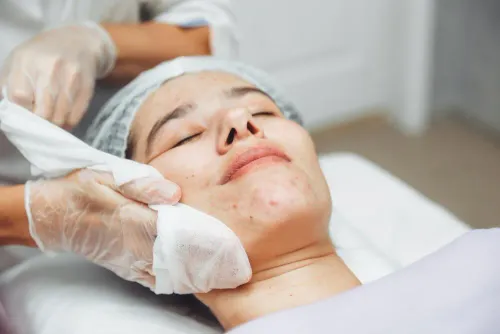
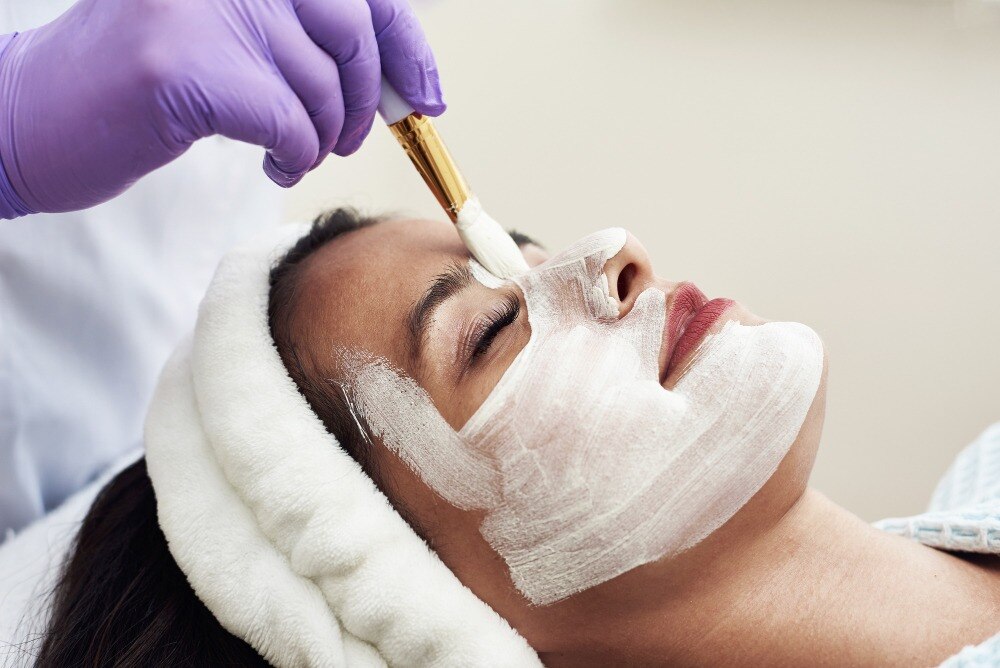
A peel appointment starts with a chemical peel consultation: the clinician examines your diagnosis, skin tone, active inflammation and treatment history before choosing the solution. They cleanse and degrease the skin, apply one or more coats for a measured contact time, then neutralize or remove the product when required.
Burning, warmth or stinging is expected; severe pain is not.
Skin preparation includes following the clinician’s instructions about pausing retinoids, exfoliating acids, benzoyl peroxide, bleaching creams and facial hair removal. Do not stop a prescribed medicine without advice.
| Disclose or manage | Why it changes the plan |
|---|---|
| Isotretinoin, including the dose and last date taken | Recent use requires individualized assessment; a fixed six-month rule does not suit every peel technique |
| Antibiotics, steroids, blood thinners or photosensitizing medicines | They can affect sensitivity, healing or bleeding risk |
| Active acne, eczema, dermatitis, open wounds, or bacterial, viral or fungal infection | Treatment should wait until the skin barrier and infection are controlled |
| Recurrent cold sores | Facial resurfacing can reactivate herpes; ask whether you need an antiviral plan |
| Laser, microneedling, waxing, fillers or other resurfacing procedures | Recent procedures can leave skin too vulnerable for another injury |
Mention allergies and any previous peel reaction. If you tan easily or have Fitzpatrick skin type IV, V or VI, ask about a conservative test area and strict sun protection; post-inflammatory hyperpigmentation is a greater concern.
Plan recovery, sun protection and the next session
Chemical peel recovery depends on depth. A superficial peel can leave burning, redness, tightness and scaling for several days; a medium-depth peel can cause swelling, crusting and longer social downtime. Do not pick, scrub or pull off loose skin: this raises the risk of infection, prolonged redness and post-inflammatory hyperpigmentation.
Resume makeup only when the skin is no longer raw, weeping or strongly stinging. After a superficial peel, that may be 24–48 hours; ask before applying makeup sooner or after a medium-depth peel.
For sunscreen after chemical peel, use the product and timing your clinician recommends once the surface tolerates it, and use a hat and shade while the skin remains tender.
- Seek medical review for increasing pain, warmth, pus, spreading redness, fever, blisters, facial swelling that worsens, eye symptoms or redness that does not settle as expected.
- Contact the clinic promptly if pigment becomes markedly darker, or if you have a history of cold sores and develop tingling or grouped blisters.
Visible light can worsen melasma, particularly in darker or easily tanning skin. Choose a tinted broad-spectrum sunscreen with iron oxides, not high SPF alone, and continue pigment treatment if prescribed. Melasma commonly returns because light, hormones and susceptibility continue driving pigment production.
RADIANCE CLINIC can make follow-up safer by recording the peel depth, products and reaction, reviewing healing before the next session, and spacing treatments until inflammation has settled. Fitzpatrick IV–VI skin often benefits from a conservative test area and a maintenance plan rather than automatically choosing a stronger peel.
Frequently asked questions
How do I identify the type of pigmentation or texture before choosing a peel?
Check whether the change is flat, raised, indented, patterned or linked to active acne. Use a close-up photograph in natural light, and ask a dermatologist to examine persistent, changing or uncertain marks.
How should I match a peel ingredient to my skin concern?
Choose the ingredient according to whether you are treating pigmentation, acne marks, active acne or uneven texture. A dermatologist can assess the concern and select an appropriate formulation.
Why does peel depth matter as much as the acid name?
Peel depth affects how deeply the treatment acts, the expected recovery period and the risk of irritation or pigment changes. Discuss depth rather than comparing acid names alone.
What should I do before a chemical peel appointment?
Tell the clinician about your current skincare products, prescription medicines and recent treatments. Follow the preparation instructions provided for your skin and planned peel.
How should I plan recovery and sun protection after a peel?
Follow the aftercare plan, protect treated skin from sunlight and avoid picking or irritating peeling skin. Arrange the next session according to your recovery and the clinician’s assessment.