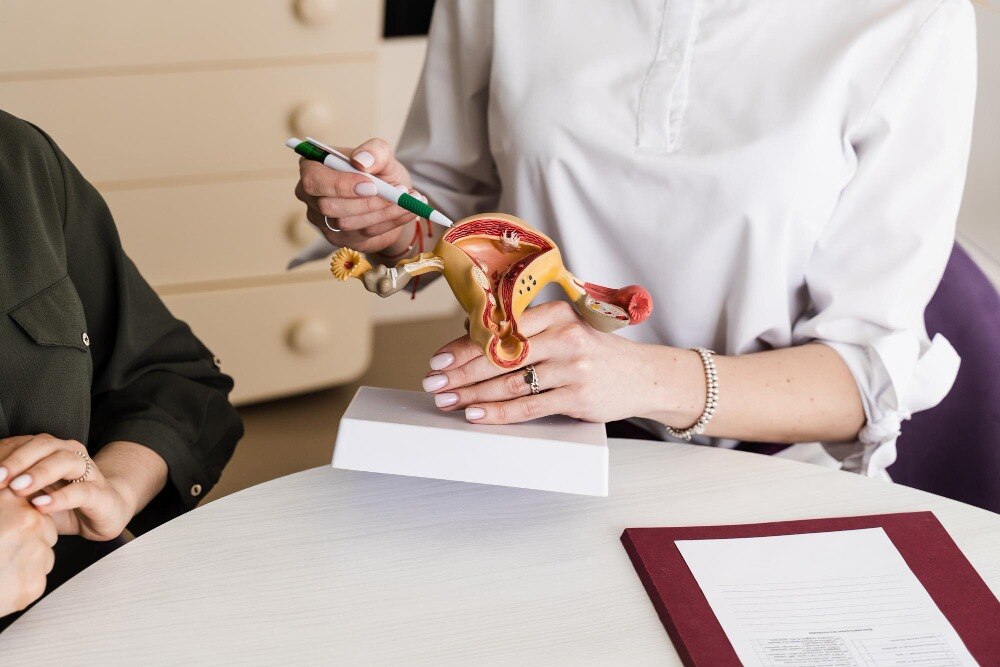
Choosing UFE starts with more than confirming that you have fibroids: their position, size, blood supply and effect on your symptoms all matter. By the end, you will know how doctors assess suitability, what the procedure and recovery involve, and how UFE compares with surgery, medication and observation.
Key takeaways
- Symptoms and fibroid location matter more than MRI size alone.
- MRI maps blood supply and the relationship between fibroids and the uterine cavity.
- Ask how pain, nausea and post-embolisation symptoms will be managed.
- Seek urgent care for heavy bleeding, fever, worsening pain or fainting after UFE.
Which Fibroids and Patients Are Suitable for UFE?
Symptoms, not an MRI finding alone, usually justify uterine fibroid embolisation suitability. Heavy bleeding, pelvic pressure, pain, urinary frequency or bowel pressure make UFE more relevant than incidentally discovered, symptom-free fibroids. Ultrasound often detects them; MRI maps their number, size, blood supply and relationship to the uterine cavity.
Fibroid type affects the discussion:
| Type | UFE suitability | Important limitation |
|---|---|---|
| Submucosal fibroids | Possible, especially when partly within the uterine wall | A fibroid projecting into the cavity may detach and pass through the cervix, causing weeks of bleeding, discharge or cramping |
| Intramural fibroids | Commonly suitable when they cause bleeding, pain or pressure | Multiple or very large fibroids may shrink without completely resolving symptoms |
| Subserosal fibroids | Possible when they are symptomatic and supplied by the uterine arteries | A stalked or unusually positioned fibroid needs careful MRI review; ask if “subserosal fibroidsost” in a report is a typographical error |
Size and number do not create an automatic exclusion. A high fibroid burden, cervical location, poor blood supply or severe cavity distortion can make another treatment more predictable. MRI findings guide that decision rather than a size threshold alone.
UFE is a poor choice during pregnancy, active pelvic infection, suspected uterine or cervical cancer, some clotting disorders or severe kidney disease affecting contrast use. If preserving fertility is a priority, discuss the uncertain pregnancy evidence with a gynaecologist or fertility specialist before choosing UFE; myomectomy may fit that goal better.
Rapid growth or postmenopausal bleeding requires investigation first.
What Tests and Checks Come Before Embolisation?
A safe UFE plan starts by confirming that fibroids explain your symptoms and that the procedure fits your anatomy, health and future pregnancy plans. A fibroid ultrasound often provides the first view; pelvic MRI for fibroids maps each lesion’s number, size, position, relationship to the uterine cavity and blood supply.
MRI also helps identify findings that need further investigation rather than embolisation.
1. Confirm the diagnosis and treatment target. Review heavy bleeding, pressure, pain, urinary or bowel symptoms, and check for abnormal bleeding patterns. Incidental fibroids without troublesome symptoms do not usually justify UFE.
2. Check pregnancy status. A pregnancy test before UFE is essential because radiation and embolisation are unsafe during pregnancy.
3. Measure blood loss and anaemia. A complete blood count detects low haemoglobin and platelet abnormalities. The search phrase complete blood count anaemia fibroidsutan does not describe a separate test; ask what your haemoglobin result means and whether anaemia needs treatment first.
4. Check procedural risks. Kidney function testing guides contrast use; review prior contrast reactions, allergies, bleeding disorders, anticoagulants, antiplatelet drugs and other medicines. Assess fever, discharge or pelvic tenderness for active infection.
5. Discuss fertility and alternatives. If you want a future pregnancy, document that UFE’s effects on fertility remain uncertain and arrange specialist counselling, including comparison with myomectomy. Suspected cancer, pregnancy or severe kidney disease may redirect treatment.
What Happens During UFE, and How Is Pain Controlled?
UFE reduces blood flow to fibroids without removing them. You remain monitored throughout, with local anaesthetic at the access site and medicine through an intravenous line for pain, nausea and anxiety.
- The team prepares your wrist or groin, cleans the skin and injects local anaesthetic. Radial artery access uses the artery at the wrist; a femoral artery catheter enters through the groin. You may feel pressure, but the skin should be numb.
- Using X-ray guidance and contrast dye, the interventional radiologist advances the catheter into the pelvic arteries. They perform selective catheterisation uterine arteries, usually treating one uterine artery and then the other while checking the blood supply.
- The operator injects calibrated embolic particles through the catheter. The particles lodge in vessels feeding the fibroids, reducing their blood supply; they do not cut the fibroids out. Imaging confirms that flow has fallen while limiting flow to the ovaries and other tissues.
- Nurses monitor your blood pressure, pulse, oxygen level and pain. Many patients receive conscious sedation rather than general anaesthesia, so you remain responsive but relaxed; the plan changes if your health or anxiety makes deeper anaesthesia safer.
- Cramping often starts during or soon after particle injection as blood flow decreases. The team treats it with prescribed analgesics, sometimes through a patient-controlled pump, and adds anti-nausea medicine when needed. Tell staff promptly if pain breaks through the planned treatment.
How Does UFE Compare with Myomectomy, Hysterectomy and Other Options?
The central trade-off is control versus recovery: removing fibroids gives more certainty, while preserving the uterus leaves open the possibility of future treatment.
| Option | Recovery and symptom control | Recurrence, uterus and pregnancy |
|---|---|---|
| UFE versus myomectomy | UFE usually means a shorter initial recovery; myomectomy may provide stronger quality-of-life improvement in comparative trials. | Both preserve the uterus, but fibroids can recur after either procedure. Myomectomy is the more established choice when future pregnancy is a major priority; discuss UFE and fertility with a specialist. |
| UFE versus hysterectomy | UFE usually involves less invasive treatment, a shorter hospital stay and faster initial recovery. | Hysterectomy ends bleeding from fibroids and removes recurrence risk in that uterus, but ends the possibility of carrying a pregnancy. UFE preserves the uterus but can require repeat treatment. |
| Medication | Hormonal medicines can reduce bleeding, but symptoms often return when treatment stops; they do not remove fibroids. | Useful for temporary control, anaemia correction or bridging to another treatment. They do not provide a definitive fibroid treatment and fertility depends on the medicine and your plans. |
| Radiofrequency ablation fibroids | Heat destroys selected fibroid tissue through a minimally invasive procedure; recovery depends on the technique and fibroid pattern. | The uterus remains, but long-term pregnancy evidence is less established than for myomectomy. |
| Watchful waiting | Avoids treatment when symptoms are mild or absent. | Choose monitoring when fibroids are not affecting daily life; worsening bleeding, pain or pressure changes the decision. |
UFE is not equivalent to removing fibroids: residual or new tissue can cause symptoms, and repeat treatment is possible. A fibroid projecting into the cavity can pass through the cervix weeks or months later, causing discharge, cramps or bleeding that needs review.
At RADIANCE CLINIC, ask how your MRI findings, pregnancy plans and alternatives change the recommendation rather than comparing procedures by recovery time alone.
Related service
Vascular And Interventional Radiology (UFE) is a minimally invasive procedure used to treat fibroid tumors of the uterus which can cause heavy menstrual bleeding, pain, and pressure on... View service → |
What Is Normal During Recovery, and Which Symptoms Need Urgent Care?
Most patients stay under observation overnight and go home the next day, though some leave the same day after pain and nausea are controlled. Post-embolisation syndrome—cramping after UFE, fatigue, nausea and a low-grade fever—usually begins within hours and improves over several days.
| Activity | Typical timing | Practical limit |
|---|---|---|
| Observation | Same day or overnight | Leave only when pain, nausea and walking are manageable |
| Desk work | About 5–10 days | Extend leave if fatigue or pain persists |
| Driving | 24–48 hours | Drive only when off opioid pain medicine and able to brake firmly |
| Lifting | About 1–2 weeks | Avoid heavy lifting until the access site is comfortable |
| Exercise | Gentle walking first; strenuous exercise after 1–2 weeks | Follow the treating team’s clearance |
Seek urgent clinical assessment for these UFE warning signs:
- Severe or worsening pelvic pain despite prescribed medicine, especially after initial improvement.
- Fever of 38°C or higher, chills, faintness, confusion or repeated vomiting.
- Foul-smelling vaginal discharge, heavy bleeding that soaks a pad each hour for two hours, or increasing redness and swelling at the catheter site.
- New shortness of breath, chest pain, one-sided leg swelling or severe allergic symptoms.
- Tissue, a firm mass or persistent bleeding passing through the vagina weeks or months later. Fibroid passage can require hysteroscopic removal; do not assume it is normal recovery.
Frequently asked questions
Which fibroids and patients are suitable for uterine fibroid embolisation?
UFE is more relevant when fibroids cause heavy bleeding, pelvic pressure, pain, urinary frequency or bowel pressure. Suitability depends on fibroid location, size, blood supply, symptoms, pregnancy plans and overall health—not an MRI finding alone.
What tests and checks come before uterine fibroid embolisation?
Ultrasound often identifies fibroids, while pelvic MRI maps their number, size, blood supply and relationship to the uterine cavity. Your clinician also reviews symptoms, medical history, medicines, pregnancy status and blood-test results before treatment.
What happens during UFE, and how is pain controlled?
A catheter delivers embolic particles through the uterine arteries to reduce blood flow to the fibroids. The care team plans pain relief and monitors symptoms during and after the procedure; ask which medicines and observation period apply to you.
How does UFE compare with myomectomy, hysterectomy and other options?
UFE treats fibroids without removing the uterus, while myomectomy removes fibroids and hysterectomy removes the uterus. The best choice depends on symptoms, fibroid anatomy, future pregnancy plans, treatment goals and medical risk.
What is normal during recovery, and which symptoms need urgent care?
Cramping, tiredness, nausea and a low-grade fever can occur during early recovery. Seek urgent medical advice for heavy bleeding, high or persistent fever, worsening pain, fainting, shortness of breath or a puncture-site problem.