The first clues are often subtle: a few blue surface veins, ankle marks from socks, or swelling that appears by evening and disappears overnight. By the end, you will know which changes fit early venous disease, which signs need prompt assessment, and what to record before speaking with a clinician.
Key takeaways
- Spider veins can coexist with deeper venous reflux, so symptoms matter.
- Aching, heaviness, itching or ankle swelling can precede bulging veins.
- Seek urgent assessment for sudden one-sided swelling, pain, warmth or redness.
- Skin darkening, hard veins and slow-healing wounds signal disease progression.
Which visible veins are early warning signs rather than a cosmetic change?
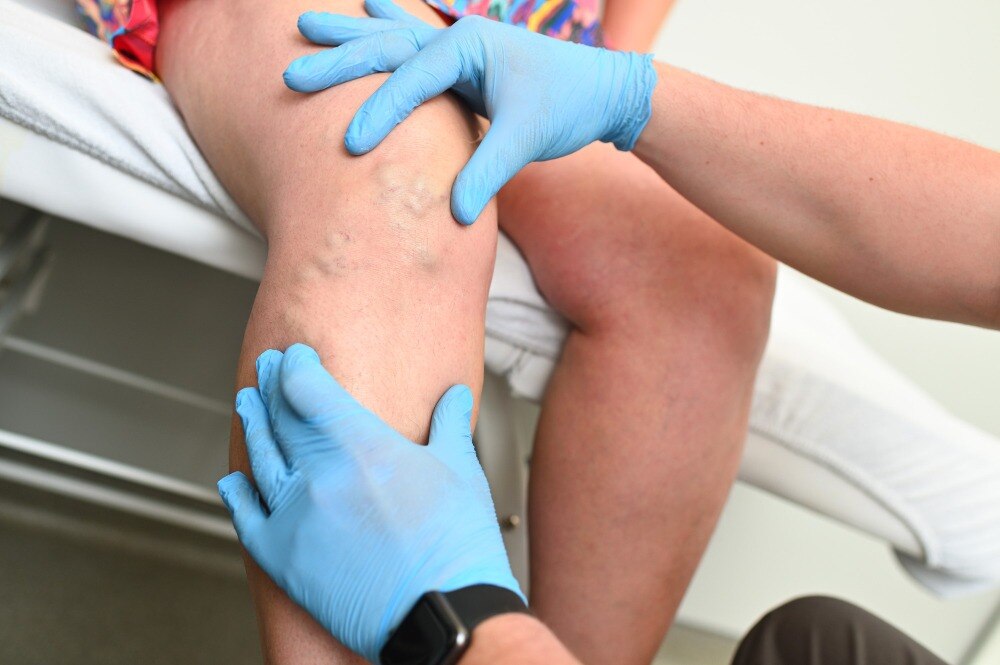
Fine blue or purple veins close to the skin are usually spider veins, not true varicose veins. The distinction is useful, but appearance alone cannot prove whether deeper venous reflux is present.
| Type | What it looks like | What the pattern suggests |
|---|---|---|
| Spider veins | Fine red, blue or purple lines in starburst or web-like branching clusters | Usually a superficial change; they can coexist with reflux but do not prove that a major vein is incompetent |
| Reticular veins | Blue-green, flat or slightly raised veins, usually 1–3 mm wide, beneath the skin | A larger feeder network than spider veins; clusters beneath spider veins deserve examination if symptoms are present |
| Varicose veins | Twisted, rope-like veins that bulge above the skin, often wider than 3 mm | More consistent with enlarged surface veins and possible venous reflux; size alone does not determine severity |
Spider veins versus varicose veins are not simply two stages of the same problem. Spider veins can remain a cosmetic change, while reticular veins or branching clusters feeding a spreading area may indicate a broader venous pattern.
A one-sided pattern, new veins around the calf or ankle, or visible veins with swelling, heaviness, itching or aching after standing deserves assessment.
A hard painful vein, ankle pigmentation, eczema, or a wound near visible varicosities moves the finding beyond cosmetic concern. A persistent or recurring wound around the ankle, known as the gaiter area, warrants vascular assessment rather than repeated self-treatment. Large bulging veins are not required for clinically important disease.
What symptoms reveal a vein problem before large veins appear?
Before a large vein appears, venous disease often creates a repeatable end-of-day pattern: aching, heaviness or swelling builds after standing or sitting and eases overnight, with walking or leg elevation.
| Symptom or home check | Pattern that raises suspicion | What to record |
|---|---|---|
| Evening ankle swelling | The ankle or lower calf looks fuller by evening and less swollen after sleep | Morning and evening appearance |
| Tight sock marks | Elastic leaves deeper grooves as the day progresses | Whether both legs show the same change |
| Warmth and itching | Warm, itchy or dry skin develops around the ankle or lower calf | Location, duration and any scaling |
| Night cramps after standing or sitting | Cramps follow a long day and improve when you move or elevate the legs | Timing, frequency and relief |
Use a simple seven-day record rather than judging one isolated episode. Note how long you stood or sat, whether walking or raising your legs helped, and whether one leg consistently changes more than the other.
At home, compare both ankles at the same time each morning and evening, take photos from the same angle, and check for reddish-brown discoloration, dryness or scaling. These checks can show a pattern, not confirm venous disease.
Do not start strong compression stockings without assessment if you have cold feet, foot pain when walking, weak pulses or known peripheral arterial disease; reduced arterial flow can make compression unsafe.
When does one-sided swelling need urgent medical assessment?
Sudden one-sided swelling is not typical of uncomplicated varicose veins. Deep vein thrombosis needs prompt medical assessment, especially when the leg is newly painful, tender, warm or heavier than the other; do not massage it or wait for a visible bulging vein.
- Varicose-vein symptoms usually build gradually, worsen after standing or sitting, and improve with walking, overnight rest or leg elevation. New swelling that appears within hours is a different pattern.
- Deep vein thrombosis often causes swelling through one calf or the whole leg, with tenderness and tight skin. You cannot rule it out by checking whether the veins look enlarged.
- Cellulitis causes spreading redness, warmth and pain in the skin, sometimes with fever or chills. A clinician still needs to distinguish it from a clot because the treatments differ.
- Muscle injury follows a clear event such as a fall, strenuous exercise or a blow, with pain linked to movement and possible bruising. Persistent or increasing swelling needs assessment even when an injury seems obvious.
- Heart- or kidney-related swelling usually affects both legs, often with breathlessness, rapid weight gain, reduced urine, or puffiness around the eyes. One-sided swelling points to a local problem instead.
A painful, firm, cord-like vein with overlying redness could be superficial vein thrombosis, which may extend toward the deep veins. Seek emergency help for sudden breathlessness, chest pain, fainting or coughing blood: these symptoms can indicate pulmonary embolism.
Which skin changes, hard veins and wounds signal progression?
A hard tender vein, ankle skin darkening, thickened skin, bleeding, or an open wound signals more than a cosmetic vein problem. These changes point to inflammation, impaired venous drainage, or tissue damage and deserve clinical assessment.
| Change | What it can indicate | Why it matters |
|---|---|---|
| Ankle discoloration with itching or scaling | Blood-cell breakdown and venous skin inflammation | Brown staining can progress beyond the ankle |
| Skin darkening and thickening | Lipodermatosclerosis, where inflamed tissue tightens | The lower leg may become firm or develop an inverted-bottle shape |
| Hard tender vein with redness | Superficial vein thrombosis | A clot can extend toward the deep veins, especially near the groin or across a long vein |
| Bleeding varicose vein | A vein has ruptured through fragile, pressurised skin | It is urgent, particularly when bleeding is heavy or keeps going |
| Open wound near the ankle or visible varicosities | A venous leg ulcer | A wound that persists or returns indicates chronic venous disease, not a minor skin injury |
If a bleeding varicose vein opens, lie down, raise the leg, and press firmly over the site with a clean dressing or cloth. Seek emergency help if bleeding does not stop promptly. Repeated bleeding needs specialist review.
Arrange assessment for a wound that fails to heal, recurs, enlarges, or develops discharge. Do not repeatedly self-treat it without checking circulation and the underlying veins.
What should happen after you notice these signs?
Arrange a clinical assessment when symptoms recur, limit walking or standing, or fail to settle overnight with leg elevation. Book sooner for ankle discoloration, a persistent or recurrent wound near the ankle, bleeding, or a firm painful vein.
New swelling mainly in one leg with warmth, tenderness or pain needs prompt assessment for deep-vein thrombosis; sudden breathlessness, chest pain or coughing blood is an emergency.
Your clinician will review risk factors for varicose veins, examine both legs and decide whether testing is needed. Duplex ultrasound uses sound waves to map the superficial and deep veins, identify venous reflux, and check for obstruction or thrombosis.
The most visible vein is not always the source of reflux, so choosing treatment from appearance alone can miss the problem.
| Option | What supports it | What happens next |
|---|---|---|
| Monitoring | Mild symptoms, no skin damage, and reassuring duplex findings | Track swelling, pain and skin changes at review |
| Symptom control | Swelling or aching without a treatment target requiring intervention | Try clinician-approved compression stockings and leg elevation; check arterial circulation before strong compression |
| Treatment discussion | Significant reflux, functional limitation, bleeding, ulceration or persistent symptoms | Compare suitable procedures with their risks, recovery and expected benefit |
A vascular clinic can match your symptoms, examination and scan rather than vein size alone. RADIANCE CLINIC can help make that monitoring-versus-treatment decision while checking whether compression stockings are safe for your circulation.
Related service
VARICOSE VEINS Varicose veins are twisty bulging veins on the legs caused by an increase in the normal venous pressure. View service → |
Frequently asked questions
Which visible veins are early warning signs rather than a cosmetic change?
Fine blue or purple spider veins are usually superficial, but they do not rule out deeper venous reflux. Bulging, twisted veins deserve assessment when they accompany pain, heaviness, itching or swelling.
What symptoms reveal a vein problem before large veins appear?
Aching, leg heaviness, tiredness, itching, burning and ankle swelling can indicate venous disease before large varicose veins become visible. Symptoms that worsen after standing and improve after elevation are especially relevant.
When does one-sided swelling need urgent medical assessment?
Sudden swelling in one leg with pain, warmth, redness or tenderness needs urgent medical assessment because deep vein thrombosis must be excluded. Seek emergency help for chest pain, sudden breathlessness or coughing blood.
Which skin changes, hard veins and wounds signal progression?
Brown or reddish skin near the ankles, eczema-like itching, firm tender veins, thickened skin and wounds that heal slowly signal worsening venous disease and require clinical evaluation.
What should happen after you notice these signs?
Arrange an assessment with a qualified clinician. They may examine both legs and request a duplex ultrasound to check blood flow, valve function and possible clots before recommending treatment.